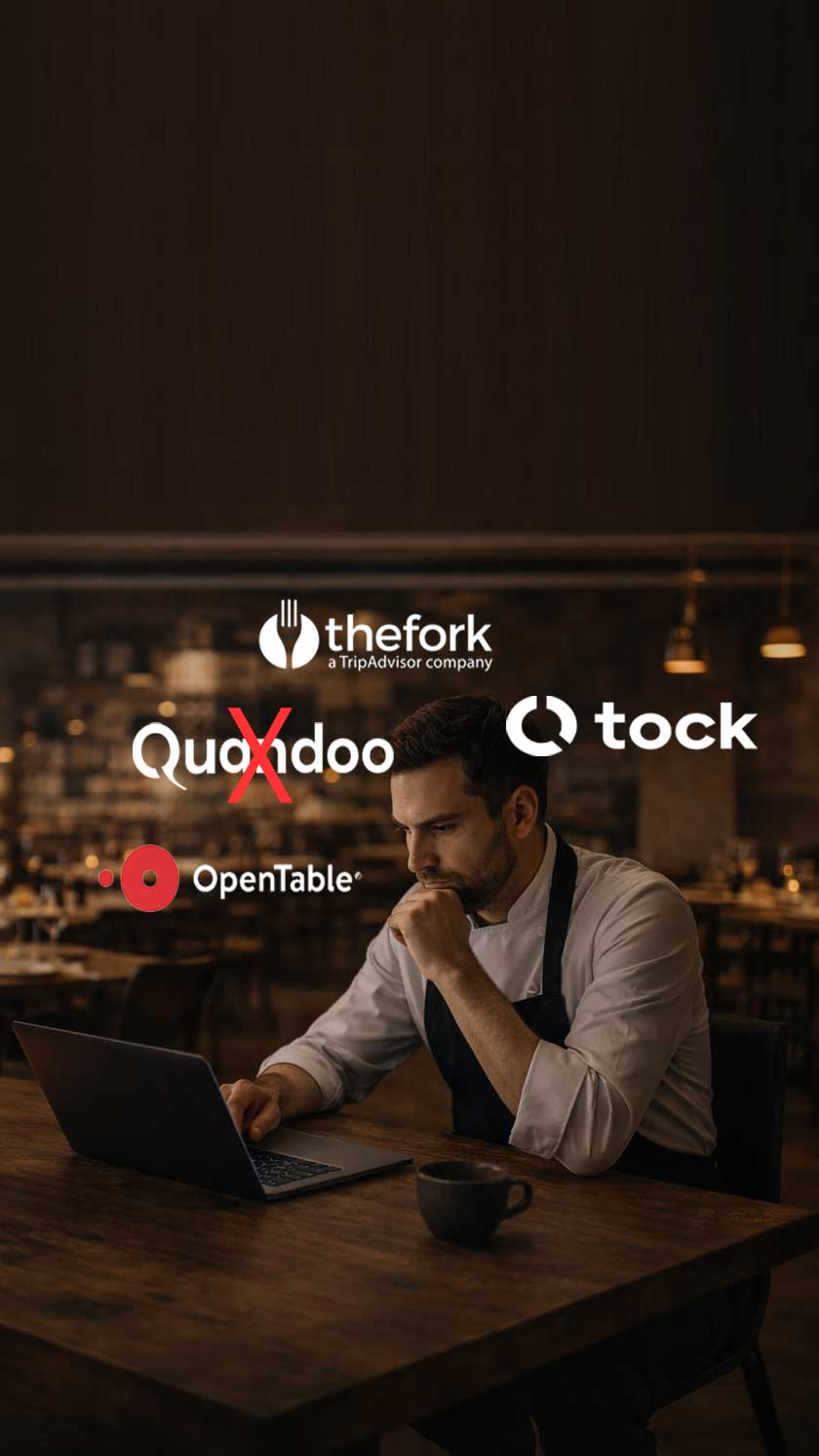
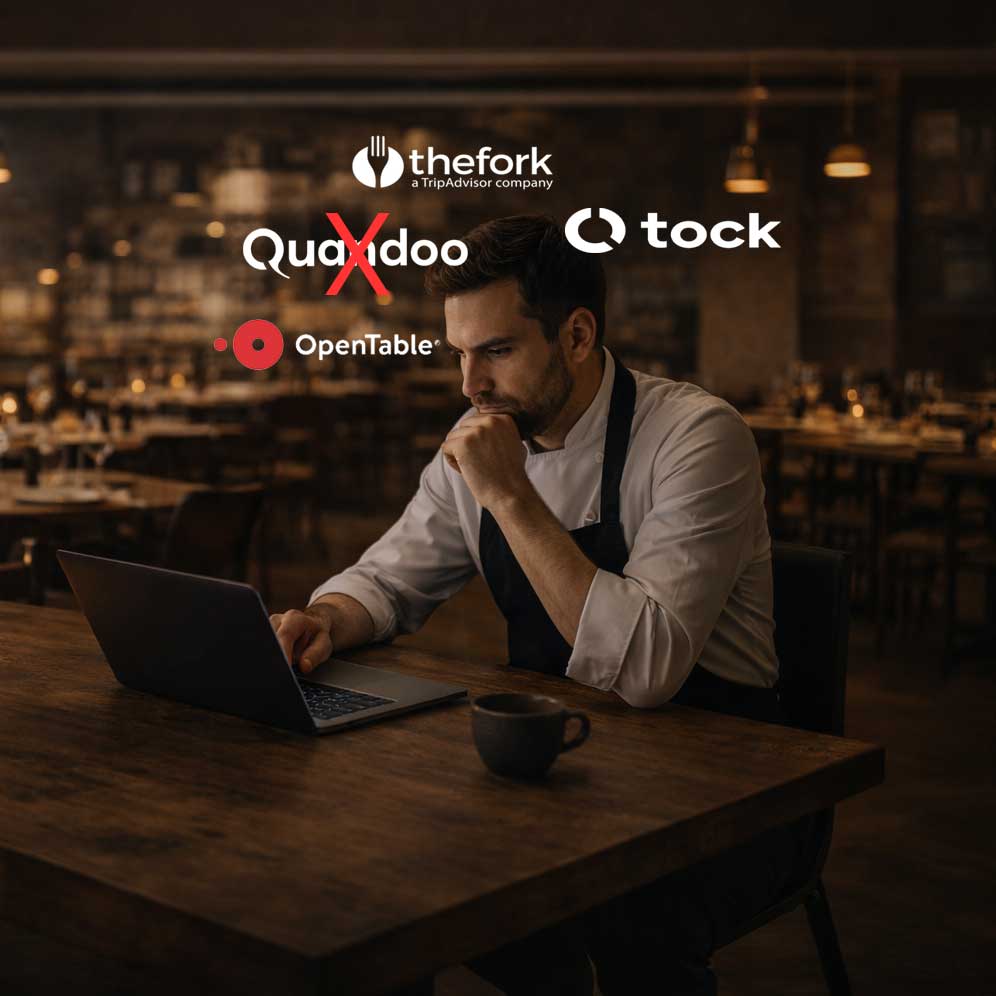
Quandoo used to belong to a Japanese recruitment company. TheFork belongs to TripAdvisor. SevenRooms belongs to DoorDash. That is no coincidence – it is a pattern. And it explains why Quandoo is shutting down.
Contents:
- Who owns the major reservation platforms – and why does it matter?
- Why the platform model is structurally working against restaurants
- What is aleno – and why is it different?
- What happens now for Quandoo restaurants?
Quandoo is shutting down. This is not a catastrophe for the restaurants affected – but it is a moment that matters for them.
For most restaurants that used Quandoo, it was a tool that worked. Reservations came in, the Google button worked, somehow it all functioned. And now it is coming to an end. Not because something went wrong, but because restaurants were never the core business for Recruit Holdings – the Japanese recruitment company that acquired Quandoo in 2015 for 219 million dollars. They were a side bet. And the side bet did not pay off.
That is the real point. And it deserves more attention than the shutdown announcement itself.
Who owns the major reservation platforms – and why does it matter?
Anyone looking for an alternative to Quandoo now is facing a landscape that, at first glance, looks large and diverse: TheFork, OpenTable, Zenchef, SevenRooms, Resy, Tock. Many names, many promises.
But if you look more closely, you notice something strange: almost none of these platforms is still owned by someone who actually cares about restaurants.
TheFork belongs to TripAdvisor – a company whose stock is at an all-time low and whose largest investor is publicly calling for TheFork to be sold. Who will own TheFork in two years: unknown.
SevenRooms was acquired for 1.2 billion dollars by DoorDash – an American delivery company whose core business is delivery, not hospitality.
OpenTable belongs to Booking Holdings, the company behind Booking.com, which has been pressuring hotels for years with commissions of 15 to 25 percent. Since April 2026, restaurants using OpenTable have been required to route all tables and all bookings through the platform – no opt-out, no exceptions. The Wolfgang Puck Group, one of the best-known restaurant groups in the world, is therefore publicly considering ending its partnership with OpenTable altogether. Their verdict: “Extremely disappointing.”
Resy and Tock belong to American Express – for whom a restaurant is above all a way to offer exclusive tables to Platinum customers.
Zenchef belongs to PSG Equity – an American growth equity fund whose business model is based on reselling portfolio companies.
Recruitment company. Travel group. Delivery service. Credit card company. Investment fund. Not a single restaurateur.
That is no coincidence. It is a pattern. And the pattern explains why Quandoo is shutting down – and why it will be no different with other platform providers.
Why the platform model is structurally working against restaurants
The fundamental problem with reservation platforms is not mismanagement. It is the business model itself.
A platform makes money by standing between the restaurant and its guests. It earns on every booking that goes through it. It earns when a regular guest books through it even though they already know the restaurant. It earns by suggesting competitors alongside the restaurant itself – and then recommending the restaurant that pays the most or fits the platform logic best, not the one that fits the guest best.
And then there is the data: who are the guests? What do they order? When do they come? How often? This information is the most valuable thing a restaurant has. On a platform, it does not belong to the restaurant. It belongs to the platform.
That is not bad intent. It is the business model.
What is aleno – and why is it different?
aleno was founded in Zurich in 2015 by a restaurateur who knew the problem from his own business. Ivica Balenovic opened Wirtschaft im Franz in 2014 – Switzerland’s first crowdfunded restaurant, now listed in the Michelin Guide. Reservation management consumed time. The available tools were either too simple or too expensive, and none of them was really built for restaurateurs. So he built his own.
Ten years later, aleno is still where hospitality actually happens – not at a distance, but right in the middle of it. aleno is part of freakstotable, a movement for artisanal food culture in the DACH region that connects chefs, producers, and restaurateurs. At Igeho 2023 and 2025, Switzerland’s largest hospitality trade fair, aleno did not have an exhibition stand – instead, the team opened a restaurant at the fair. Guests paid nothing. Because hospitality is not something you pitch, it is something you live.
The team brings more than 46 years of hospitality experience. Not as a line on a résumé, but as practical knowledge of how businesses really work.
What that means in concrete terms:
- No marketplace. There is no platform where guests are shown and recommended other restaurants as well.
- No commission per booking. The price is a fixed monthly fee, regardless of booking volume.
- The guest data belongs to the restaurant. Completely, exportable, at any time.
- DACH is not a market on a spreadsheet. It is the only market.
Today, 2,300 restaurants and hotels in Germany, Austria, and Switzerland work with aleno – including seven of Switzerland’s ten best hotels, L'Osteria, Hotel Sacher, Steirereck, and Tantris. Not because aleno was the loudest, but because the model works.
What happens now for Quandoo restaurants?
In practical terms: Quandoo restaurants need to act. Anyone who does not have a functioning replacement by the end of September risks suddenly receiving no more reservations at all – and guests who want to book via Google will hit a dead end. This is not a theoretical problem. It happens at exactly the moment you need it least.
The technical question – which system, how to migrate, what happens to the guest data – can be solved (aleno handles the migration in full, guest data is transferred, and the Google presence remains in place. Anyone switching now pays nothing until the end of September).
But the really interesting question is a different one.
Anyone who is now forced to decide again has a choice: keep relying on platform logic – or get out of it? Never again commissions for guests who would have booked via Google anyway. Never again guest data owned by a corporation. Never again a system whose continued existence depends on whether investors in Tokyo or San Francisco believe restaurants are a good side bet.
Quandoo is shutting down. This is the moment. Not to quickly find a new platform. But to stop needing one altogether.